
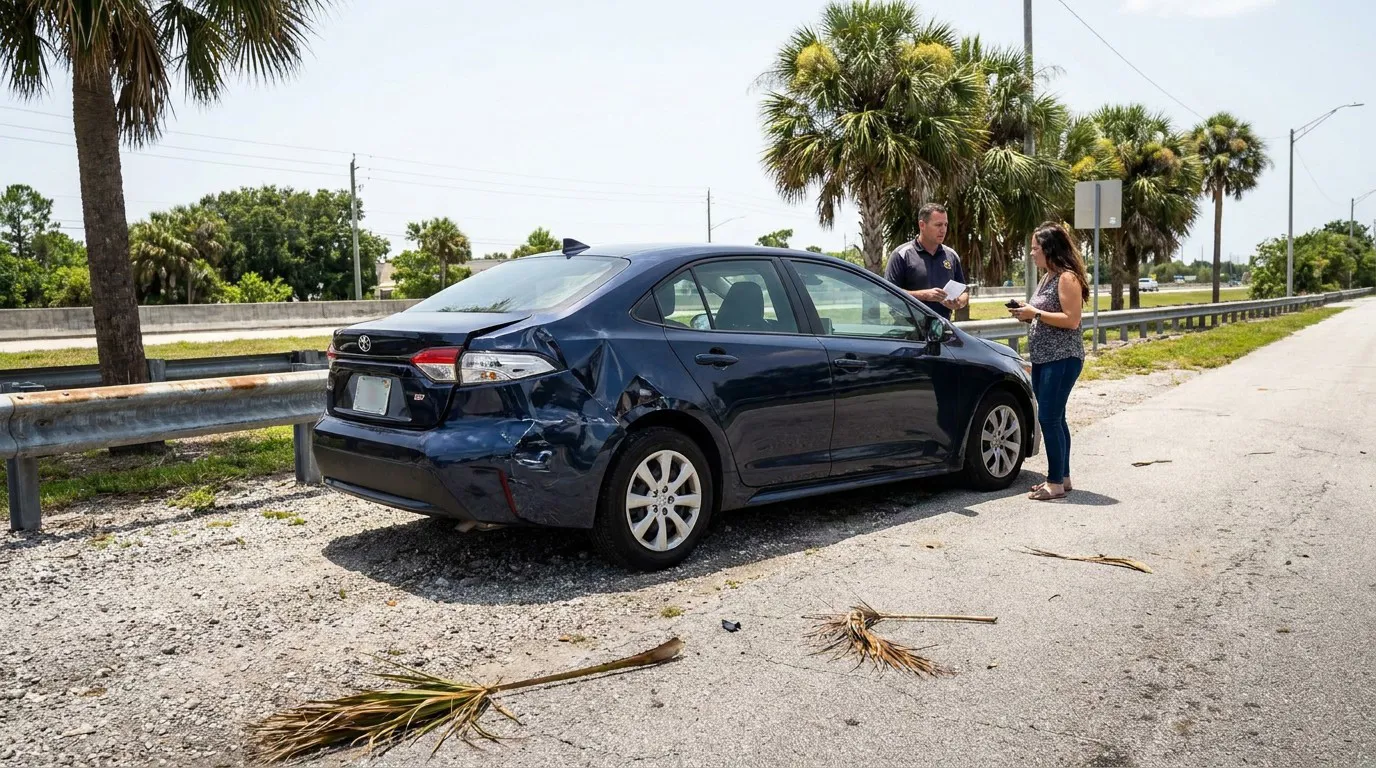
Understanding Your Rights After an Uninsured Driver Hits You in The Villages
Key Takeaways: If an uninsured or underinsured driver hits you in Florida, your uninsured motorist (UM) coverage becomes your primary compensation source. UM coverage is automatically included in your policy unless rejected in writing and extends to underinsured drivers and insolvent insurers. To file a UM claim, obtain a police report, seek medical care, notify your insurer, preserve evidence, and document damages. Understanding whether your policy is stacking or non-stacking is critical, and UM benefits cannot be reduced by PIP setoffs. Acting promptly preserves your strongest footing for fair recovery.
Getting hit by a driver who has no insurance can leave you stranded with medical bills, lost wages, and no clear path to compensation. Florida is a no-fault state, yet many drivers carry only minimum coverage. Your own uninsured motorist (UM) coverage fills that gap, and knowing how to file a UM claim can mean the difference between denial and fair recovery. This guide walks Villages residents through the process, the law, and practical steps that protect your claim.
If you were injured by an uninsured driver, Glover Law Firm is ready to help. Call 352-205-4495, visit our firm website, or message us through our online contact page to discuss your situation.
What Happens If Someone Without Insurance Hits You in Florida
Your own coverage becomes your primary compensation source when an uninsured driver hits you in Florida. Florida’s no-fault system requires personal injury protection but doesn’t require bodily injury liability coverage that pays for harm caused to others. Florida law requires motor vehicles registered in Florida carry at least $10,000 in personal injury protection (PIP) and $10,000 property damage liability (PDL) coverage. Because liability coverage isn’t mandatory, you can be seriously hurt by a driver who cannot pay.
This gap is what UM coverage addresses. Under Florida law, an "uninsured motor vehicle" includes drivers with zero coverage, insolvent insurers, and underinsured drivers. The term includes an insured motor vehicle when the liability insurer is unable to make payment because of insolvency, or has provided limits less than the total damages sustained. That means UM benefits may apply even when the at-fault driver carried some insurance, just not enough.
💡 Pro Tip: Before assuming you have no recovery options, check your auto policy for "uninsured/underinsured motorist" coverage. Many Villages drivers have it without realizing it.
Why UM Coverage Matters Under Florida Law
UM coverage matters because Florida treats it as built-in protection that insurers must offer every policyholder. The Legislature made this protection a default feature of liability policies. You can review the controlling provisions in the uninsured motorist statute.
How UM Coverage Becomes Part of Your Policy
UM coverage is automatically part of your policy unless you formally reject it in writing. No motor vehicle liability insurance policy providing bodily injury liability coverage shall be delivered or issued in Florida unless uninsured motor vehicle coverage is included under Fla. Stat. § 627.727(1). If you never signed a rejection, your insurer must provide this coverage. A valid rejection must use a specific Office of Insurance Regulation form warning you in 12-point bold type about the consequences.
Your UM limits typically track your liability limits. The limits of uninsured motorist coverage shall be not less than the limits of bodily injury liability insurance purchased, or such lower limit as selected by the named insured, under Fla. Stat. § 627.727(2). If you selected lower limits, that choice generally carries forward to renewal policies unless you request higher coverage in writing.
Stacking vs. Non-Stacking UM Policies
Knowing whether your policy is stacking or non-stacking is critical before filing a UM claim. Florida insurers may file revised premium rates reflecting at least 20 percent reduction in uninsured motorist coverage premium for policies with non-stacking limitations, under Fla. Stat. § 627.727(9). If you accepted that discounted option, coverage provided for two or more motor vehicles cannot be added together to determine the limit available to an injured person for any one accident.
| Policy Type | How Coverage Applies |
|---|---|
| Standard (stacking) | May combine UM limits across covered vehicles |
| Limited (non-stacking) | Restricted to the single vehicle involved, often at a 20% premium discount |
There’s an important exception for people not occupying a vehicle. Under a limited policy, if you were struck as a pedestrian or cyclist, the rules shift. If the injured person is not occupying a motor vehicle at the time of the accident, she or he is entitled to select any one limit of uninsured motorist coverage for any one vehicle afforded by a policy under which she or he is insured as a named insured or as an insured resident of the named insured’s household, under Fla. Stat. § 627.727(9)(e).
Steps to File a UM Claim After a Crash
Filing a UM claim follows a sequence that begins at the scene and continues through your insurer’s review. These steps help protect your right to full compensation:
- Report the crash promptly and obtain a police report confirming the other driver’s lack of insurance.
- Seek medical care immediately and follow through with treatment to document your injuries and causation.
- Notify your own insurer that you intend to pursue a UM claim under your policy.
- Preserve evidence such as photos, witness contact information, and repair estimates.
- Track all damages, including medical bills, lost wages, and out-of-pocket costs.
Documenting Your Claim Thoroughly
Strong documentation often separates a smooth claim from a contested one. Insurers evaluating a UM coverage auto accident claim will scrutinize whether your injuries connect to the crash and whether your damages are reasonable. Consistent medical records, gap-free treatment, and clear proof of lost income strengthen your position.
💡 Pro Tip: Keep a simple injury journal noting pain levels, missed work, and how the crash affects daily activities. This contemporaneous record can support your non-economic damages.
UM benefits are supplemental, not duplicative. UM coverage shall be over and above, but shall not duplicate, benefits available under workers’ compensation law, personal injury protection benefits, and shall cover the difference between such benefits and damages sustained, up to the maximum coverage amount. The amount of coverage available shall not be reduced by a setoff against any coverage, including liability insurance, under Fla. Stat. § 627.727(1). This anti-setoff rule preserves the full value of your UM coverage.
Other Sources of Recovery Beyond Your UM Policy
Your UM policy isn’t always the only avenue, especially when someone else’s vehicle was involved. If you were hurt as a passenger in another person’s car, additional coverage may apply. If the injured person is occupying a motor vehicle not owned by her or him or by a family member residing with her or him, the injured person is entitled to the highest limits of uninsured motorist coverage afforded for any one vehicle as to which she or he is a named insured or insured family member. Such coverage shall be excess over the coverage on the vehicle occupied, under Fla. Stat. § 627.727(9)(c).
Vehicle owners may also share responsibility under certain circumstances. When an owner loans a car to a permissive user who is uninsured, Florida’s financial responsibility law in Chapter 324 may create secondary exposure. The owner who is a natural person and loans a motor vehicle to any permissive user shall be liable only up to $100,000 per person and up to $300,000 per incident for bodily injury and up to $50,000 for property damage. If the permissive user is uninsured or has insurance with limits less than $500,000 combined property damage and bodily injury liability, the owner shall be liable for up to an additional $500,000 in economic damages only, under Fla. Stat. § 324.021(9)(b)(3). For more on these scenarios, our overview of a car accident uninsured driver FL explains your no-fault rights.
💡 Pro Tip: Identify every potentially responsible party early. A vehicle owner, rental company, or your own UM policy can sometimes be layered together to reach your full damages.
Common Challenges When Filing a UM Claim
Even valid UM claims can run into resistance. Adjusters may dispute soft-tissue injury severity, question treatment gaps, or argue that your damages fall below your available benefits. Florida’s pure comparative negligence framework can also reduce recovery if you’re found partly at fault. You can verify state requirements through the official Florida insurance requirements resource.
Penalties for driving uninsured exist but don’t guarantee recovery. Failure to maintain required insurance coverage may result in driver license or registration suspension and a reinstatement fee of $150 to $500. These administrative consequences are separate from your civil claim and don’t directly compensate you, which is why your own UM coverage is so important. Guidance from a knowledgeable auto accident lawyer The Villages can help you navigate these obstacles.
Frequently Asked Questions
1. Do I have to prove the other driver was uninsured to file a UM claim?
Yes, you must show the at-fault vehicle qualifies as uninsured or underinsured. A police report and your insurer’s investigation typically establish this.
2. Can my insurer reduce my UM payout because I received PIP benefits?
No, your UM coverage cannot be reduced by a setoff against other coverage. Under Fla. Stat. § 627.727(1), UM benefits sit over and above PIP and workers’ compensation.
3. What if I rejected UM coverage years ago?
A prior rejection generally carries forward to renewal policies unless you request coverage in writing. However, if the original rejection didn’t meet statutory form requirements, its validity may be challenged.
4. Does UM coverage apply if I was a pedestrian or passenger?
Yes, and the rules may work in your favor. A passenger in a non-owned vehicle may access the highest UM limits available to them as a named insured, and that coverage is excess.
5. How soon should I act after an uninsured driver crash?
Act promptly to preserve evidence and meet policy notice requirements. Florida civil deadlines and your policy’s notice terms both matter. Acting early protects your ability to file UM claim Florida benefits without disputes.
Protecting Your Recovery After an Uninsured Driver Crash
When an uninsured or underinsured driver upends your life, Florida law gives you tools to pursue compensation through your own UM coverage and, in some cases, from responsible vehicle owners. Understanding your policy type, documenting your injuries, and identifying every source of recovery are the foundation of a strong claim.
If an uninsured driver crash in The Villages has left you with mounting bills and unanswered questions, Glover Law Firm is here to guide you. Call us today at 352-205-4495, learn more on our main website, or reach out through our secure contact form to take the next step toward protecting your recovery.