

When a Crash Makes an Old Injury Worse: Your Rights in The Villages
Key Takeaways: Aggravation of a pre-existing injury under Florida law generally occurs when a new traumatic event, such as a car crash, accelerates or worsens a condition you already had, producing new pain, disability, or a need for treatment. Florida law may allow recovery for that measurable worsening, though generally not for the underlying condition that existed before the collision. Causation is often the central battleground, and medical evidence comparing pre-crash and post-crash imaging, function, and symptoms is frequently what decides the question. Florida’s PIP system typically pays first for medically necessary accident-related care, subject to a 14-day treatment requirement and statutory limits, with recovery beyond those limits potentially pursued through a bodily injury claim against the at-fault driver, a claim that, for pain and suffering damages, generally requires meeting the permanent injury threshold in Fla. Stat. § 627.737(2). Modified comparative negligence under Fla. Stat. § 768.81, as amended in 2023, may reduce or bar recovery for claims accruing on or after March 24, 2023, and negligence actions accruing on or after that date generally must be filed within two years. Gaps in treatment, undisclosed prior records, and insurer arguments about arthritis or degeneration are common obstacles that thorough documentation may help address.
If you already lived with a bad back, an arthritic knee, or a prior neck injury before your crash, and the collision made that condition dramatically worse, Florida law may allow you to pursue compensation for the worsening itself. Aggravation generally means a new traumatic event accelerates, worsens, or combines with a condition you already had to produce new pain, disability, or a new need for treatment. Insurance adjusters frequently argue your symptoms are just the natural march of age or degeneration. Florida courts have long recognized that a negligent driver generally takes the injured person as they find them, subject to proof and the specific facts of each case.
If a collision in The Villages left you hurting in ways your old injury never caused before, you deserve straight answers. The team at Glover Law Firm helps injured residents document how a crash changed their baseline health. Call 352-205-4495 or contact us now to discuss your situation.
How Florida Law Treats Aggravation of Pre-Existing Injury Claims
Florida’s approach to aggravated conditions traces back to decades of settled injury jurisprudence. The principle appears in the workers’ compensation context, where a 1966 Florida Supreme Court decision addressed a claim where a new workplace incident combined with a prior physical condition, with the court drawing a distinction between aggravation of a pre-existing injury and a pre-existing condition that merely retarded recovery from a compensable injury. Workers’ compensation standards differ from negligence standards, so those cases illustrate the causation concept rather than control a civil auto claim.
The same causation logic generally carries over into auto litigation. A defendant typically cannot escape responsibility simply because the injured person was already vulnerable. What the defendant may be responsible for, however, is generally the measurable worsening, not the pre-existing condition. Where evidence does not permit apportionment between the prior condition and the aggravation, Florida juries may be instructed that the defendant is responsible for the entire condition.
The Difference Between a New Injury and an Aggravation
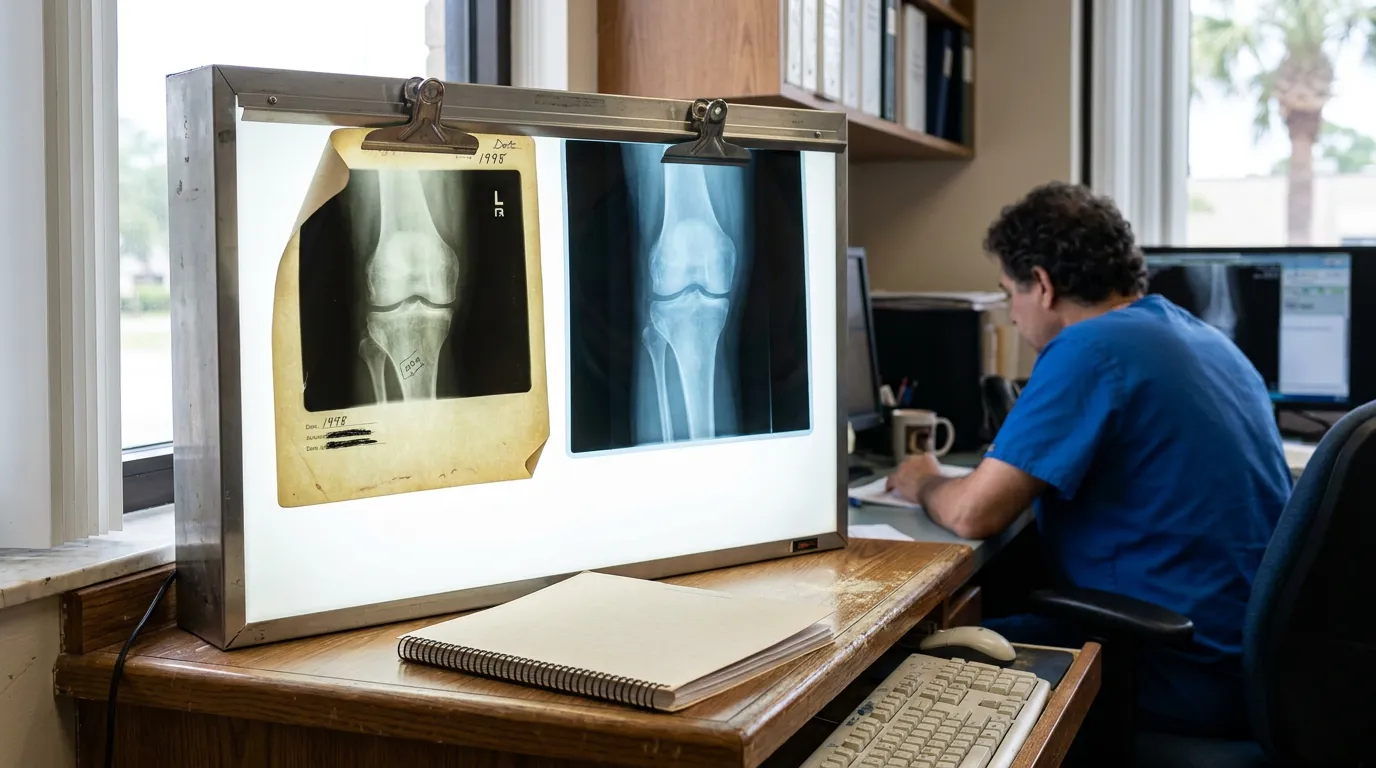
A new injury generally starts from a healthy baseline, while an aggravation builds on an existing one. That distinction matters because it may shape what portion of your treatment and disability a jury attributes to the at-fault driver. Courts may consider imaging comparisons, treatment gaps, and symptom history when drawing that line.
Medical evidence usually decides the question. Testimony from treating physicians is often necessary to separate natural progression of a degenerative condition from a material aggravation caused by the collision. Without that evidence, a car accident pre-existing condition claim can become difficult to sustain.
Why Adjusters Target Prior Medical Records
Insurers routinely request years of medical history after a worsened injury crash claim is filed, frequently searching for any earlier complaint involving the same body part. A prior chiropractic visit or an old MRI showing degeneration can become the centerpiece of a denial letter. Not every such request is enforceable, however; Florida discovery rules generally limit medical disclosure to conditions placed at issue in the claim.
💡 Pro Tip: Ask your treating physician to document, in writing, how your function and pain levels differed before and after the crash. Contemporaneous comparison notes are often more persuasive than testimony reconstructed months later.
Proving Causation in a Pre-Existing Condition Injury Claim
Causation is the battleground in nearly every aggravated injury case. You generally must show the crash materially contributed to worsening your condition rather than the condition simply progressing on its own. Broad guidance on aggravation of a preexisting condition explains that medical proof is central to establishing that link, a concept that applies across injury systems, even though specific legal tests vary by system and state.
Practical documentation may strengthen the causal story considerably. Consider gathering:
- Pre-crash imaging and treatment notes establishing your functional baseline
- Post-crash imaging performed reasonably soon after the collision
- Records of activities, work duties, or hobbies you managed before but cannot manage now
- Statements from family or neighbors describing observable changes
- A consistent, gap-free course of medical care following the crash
Gaps in treatment can create real litigation risk. When weeks pass without care, defense counsel may argue the crash caused only a transient flare-up. Outcomes here are highly fact-dependent.
Florida’s PIP System and Aggravated Injury Damages
Florida’s no-fault framework usually pays first, regardless of who caused the crash. Under Fla. Stat. § 627.736(1), PIP insurers must provide benefits for bodily injury, sickness, disease, or death arising out of the ownership, maintenance, or use of a motor vehicle. That language may become the foundation for arguing a crash worsened a prior injury, though the insurer may still dispute whether treatment relates to the crash.
Benefit amounts and medical necessity requirements are set by statute. Fla. Stat. § 627.736(1)(a) requires medical benefits to cover 80 percent of reasonable expenses for medically necessary services related to accident injuries, generally up to a $10,000 combined limit, and only if initial services are received within 14 days of the crash. Benefits may be capped at $2,500 unless a qualifying provider determines the injured person had an emergency medical condition. Reviewing the Florida PIP benefits statute helps clarify how insurers evaluate accident-related treatment.
| Issue | What Generally Applies |
|---|---|
| Initial medical coverage | PIP benefits, subject to the 14-day rule, statutory limits, and medical necessity |
| Recovery beyond PIP | Bodily injury liability claim against the at-fault driver; pain and suffering generally requires meeting the § 627.737(2) threshold |
| Fault allocation | Modified comparative negligence under Fla. Stat. § 768.81 for claims accruing on or after March 24, 2023 |
| Medical damages evidence | Amounts paid, due and owing, and reasonable future care, per Fla. Stat. § 768.0427 |
| Filing deadline | Generally two years for negligence accruing on or after March 24, 2023, under Fla. Stat. § 95.11 |
Recoverable medical damages are generally tied to actual costs rather than billed charges. For actions filed after March 24, 2023, Fla. Stat. § 768.0427 generally limits evidence of past medical damages to amounts actually paid, amounts due and owing, and, for future care, amounts reasonably necessary under the statute’s formulas. Understanding the average car accident settlement Florida claimants see can set realistic expectations, though past results never predict any individual outcome.
Comparative Fault Can Reduce or Eliminate Prior Injury Compensation
Florida applies a modified comparative negligence standard to most negligence actions. Under the statute as amended in 2023, any party found to be greater than 50 percent at fault for his or her own harm generally may not recover damages. That bar does not apply to medical negligence actions, and claims accruing before March 24, 2023, are generally governed by the prior pure comparative fault rule, under which recovery was reduced but not barred.
Below that threshold, damages are generally reduced in proportion to fault. A claimant found 20 percent responsible would typically see an award reduced accordingly, subject to exceptions and the specific procedural posture of the case. Careful investigation of the collision itself is therefore just as important as the medical proof.
Golf Cart and Low-Speed Vehicle Considerations
The Villages sees substantial golf cart traffic, which raises distinct coverage questions. Whether PIP applies can depend on the vehicle’s classification and the insurance policies involved; traditional golf carts generally fall outside Florida’s definition of a motor vehicle for PIP purposes, while registered low-speed vehicles are generally treated differently. Working with a The Villages car accident lawyer familiar with local roadway and multi-modal path conditions can help identify every available coverage source.
Deadlines That Can End a Worsened Injury Crash Claim
Timing rules in Florida negligence cases are generally strict and enforced by courts. For causes of action accruing on or after March 24, 2023, Florida Statutes classify an action founded on negligence as one that generally must be brought within two years. Claims that accrued before that date were generally governed by the prior four-year period under Fla. Stat. § 95.11(3)(a), so the applicable deadline can depend on when your crash occurred.
Exceptions exist, but courts often interpret them narrowly. Tolling and delayed discovery may apply in limited circumstances, and nothing about those doctrines is automatic. Claims involving government entities generally follow separate notice requirements under Fla. Stat. § 768.28, including a written notice of claim and a pre-suit waiting period, distinct from a civil lawsuit against a private driver.
💡 Pro Tip: Confirm your specific deadline early rather than assuming the general rule applies. Waiting until a limitations period nears its end can restrict your options considerably.
Frequently Asked Questions
1. Can I recover if my back problems existed long before the crash?
In many cases, potentially yes. A defendant may be responsible for aggravation of a pre-existing injury in Florida, though recovery is generally limited to the worsening rather than the underlying condition, unless the evidence makes the two impossible to separate.
2. Should I tell my doctor about my prior injury?
Yes, and promptly. Concealing prior treatment can seriously damage credibility if the records surface later, which they often do during discovery.
3. How do doctors prove a crash worsened my condition?
Physicians generally compare pre-crash and post-crash imaging, function, and symptoms. Competent medical testimony, often from a treating physician or retained expert, is generally needed to establish material aggravation rather than natural progression.
4. Does PIP cover treatment for an aggravated old injury?
PIP may cover medically necessary treatment related to the accident, subject to the 14-day treatment rule and statutory limits. Coverage disputes over causation are common in these claims.
5. What if the insurer blames arthritis or degeneration?
That defense is routine and not necessarily fatal to a claim. Thorough medical documentation may frequently address it, though results depend entirely on the individual facts.
Protecting Your Health and Your Claim After a Villages Collision
Aggravation of a pre-existing injury in Florida is a recognized potential basis for recovery, but it generally demands careful medical proof, prompt treatment, and attention to statutory deadlines and fault allocation. The governing framework draws from Florida’s PIP statute, the comparative negligence rule in Fla. Stat. § 768.81, and long-standing causation principles reflected in Florida case law. Because several of these rules changed in 2023 and apply based on when a claim accrued, the date of your crash can materially affect your rights. Every case turns on its own facts, and no outcome can be predicted in advance.
You do not have to untangle these rules alone while you are still recovering. Reach out to Glover Law Firm by calling 352-205-4495 or schedule your consultation to learn how Florida law may apply to your worsened injury.
Disclaimer: This content is for informational purposes only and is not legal advice. Every case is unique, and results may vary. Consult an attorney about your specific circumstances.