
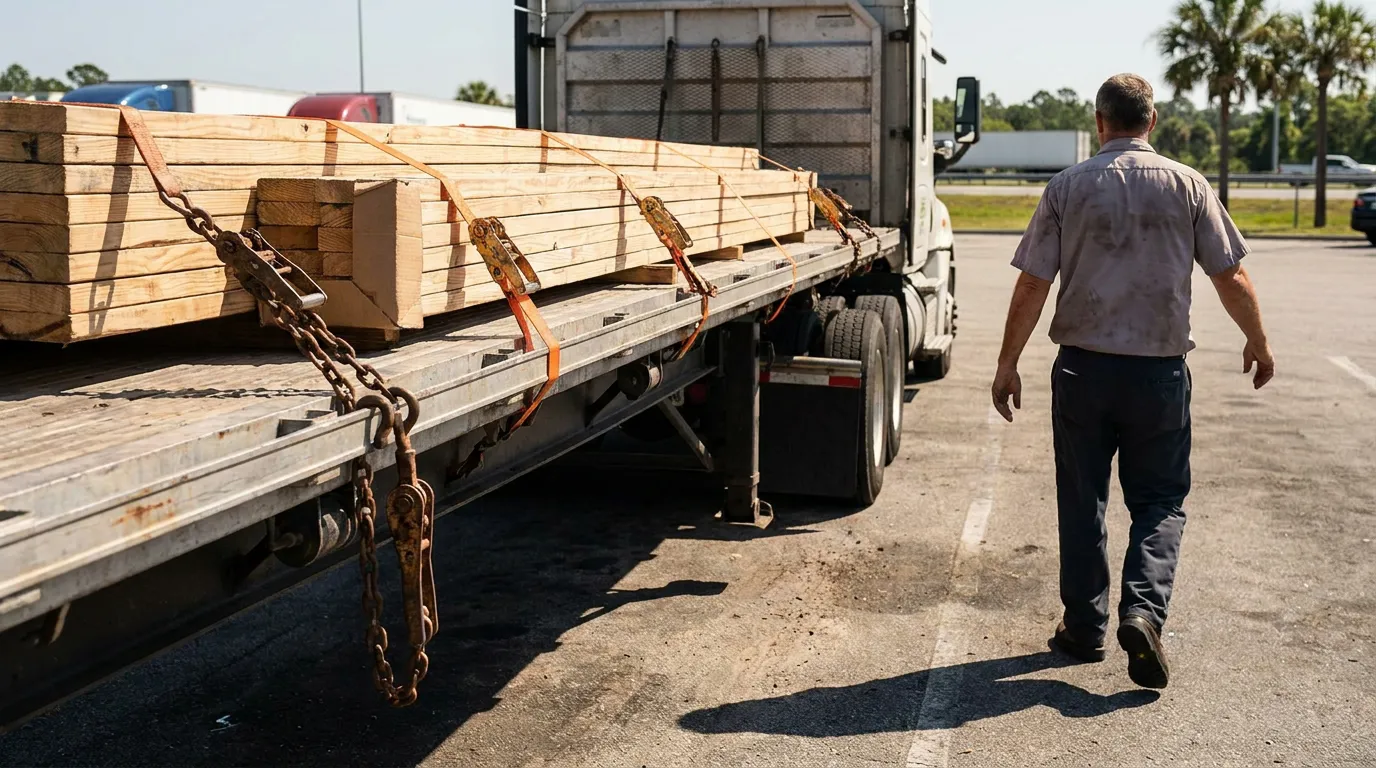
When a Truck’s Load Becomes a Hazard on Ocala Roads
Key Takeaways: Cargo securement failures in Ocala semi-truck crashes often trace to identifiable regulatory violations rather than bad luck. Federal rules at 49 C.F.R. Part 393, Subpart I set tiedown, working load limit, and commodity-specific standards, and Florida adopts those federal parts through Fla. Stat. § 316.302, while §§ 316.520 and 316.515(3) add general load securing, covering, and size limits. A violation may be evidence of breach, though Florida courts generally treat a traffic-statute violation as evidence of negligence rather than automatic liability, and duty, causation, and damages must still be proven, often through reconstruction, medical records, and carrier documentation. Liability can extend beyond the driver to the motor carrier, shipper, loading company, broker, or equipment manufacturer. Florida’s modified comparative fault rule generally reduces damages by a claimant’s share of fault and may bar recovery above 50 percent in most negligence actions. Because bills of lading, ELD data, camera footage, and the tiedowns themselves can disappear quickly, early preservation efforts are often critical.
Cargo that shifts, slides, or falls from a semi-truck is rarely a freak accident. It often traces back to a measurable failure: too few tiedowns, the wrong working load limit, an uncovered load, or a rushed loading crew. These failures matter legally because federal regulations and Florida statutes impose specific, enforceable duties on carriers, drivers, and the companies that load freight. When an unsecured load causes a crash on I-75, U.S. 27, or a rural Marion County highway, the regulatory violation may become the backbone of the injury claim.
If you or a family member was hurt by falling freight or a jackknifed trailer, the team at Glover Law Firm can help you understand your options. Call 352-484-0775 or contact us now to discuss what happened and what evidence may still be recoverable.
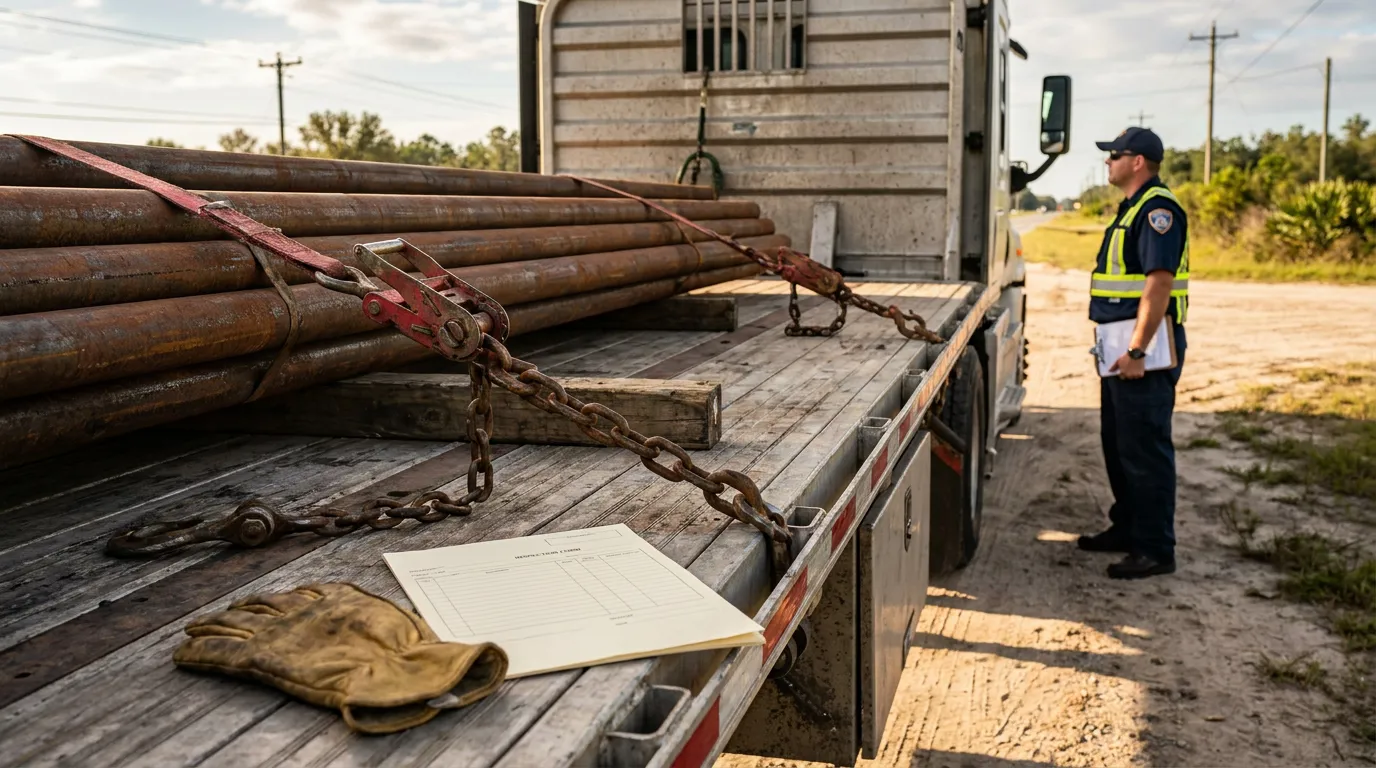
The Federal Rules Behind Cargo Securement Violations Truck Accidents
Federal law sets the controlling performance standard for how freight must be restrained during transport. The FMCSA’s cargo securement rules, codified at 49 C.F.R. Part 393, Subpart I, require cargo to be firmly immobilized so it cannot shift or fall while the vehicle is in motion. These rules generally apply to commercial motor vehicles subject to the Federal Motor Carrier Safety Regulations, including trucks, truck tractors, semitrailers, full trailers, and pole trailers, subject to Part 390 exemptions.
The regulations contain specific arithmetic. Section 49 C.F.R. § 393.102 establishes minimum performance criteria (including working load limits) for cargo securement devices, § 393.106 sets the aggregate working load limit for tiedowns, and § 393.110 dictates how many tiedowns are required based on the length and weight of the cargo, all as part of the broader cargo securement framework found in 49 C.F.R. Part 393, Subpart I (§§ 393.100-393.136). A reconstruction of the load may show the aggregate working load limit fell short of what the rule required, giving a claim something more concrete than a general allegation of carelessness.
Commodity-Specific Standards That Often Come Into Play
Certain cargo types carry their own dedicated rules. Sections 49 C.F.R. §§ 393.116 through 393.136 address commodity-specific cargo securement standards for logs, dressed lumber, metal coils, paper rolls, concrete pipe, intermodal containers, automobiles, heavy vehicles/equipment/machinery, flattened or crushed vehicles, roll-on/roll-off containers, and large boulders. Heavy machinery is covered by its own commodity-specific rule at § 393.130, while the general cargo securement rules are found in §§ 393.100 through 393.114. Marion County sees agricultural freight, horse trailers, building materials, and timber, so the applicable commodity rule may determine which standard the carrier had to meet.
How Florida Law Reinforces the Federal Standard
Florida adopts the federal framework directly rather than leaving cargo securement to federal regulators alone. Under Fla. Stat. § 316.302(1)(a), owners and drivers of commercial motor vehicles operating in interstate commerce on Florida’s highways are "subject to the rules and regulations contained in 49 C.F.R. parts 382-386 and 390-397." Subsection (1)(b) applies the same parts to intrastate carriers as those regulations existed on December 31, 2023. A federal securement violation may thus simultaneously be a violation of Florida statutory law.
That incorporation is also largely exclusive. Fla. Stat. § 316.302(1)(d) provides that this section supersedes other commercial motor vehicle safety requirements in Chapter 316, subject to a narrow exception for rear overhang lighting and flagging under § 316.228. That may mean FMCSA’s securement standards, rather than general state load statutes, supply the controlling standard in a semi-truck cargo case, although the common-law duty of reasonable care applies independently.
The General Florida Load Statutes Still Matter
Chapter 316 contains foundational load rules that apply broadly to vehicles on Florida roads. Fla. Stat. § 316.520 requires that a vehicle’s load be secured against becoming loose, detaching, or spilling, and related subsections address covering loads capable of shifting, spilling, or blowing off, plus penalties for noncompliance. Because a violation is a noncriminal traffic infraction, Florida courts generally treat it as evidence of negligence rather than negligence per se, depending on the statute’s purpose and the facts.
Size and configuration limits can matter just as much as tiedowns. Fla. Stat. § 316.515(3) generally limits a combination to one truck tractor and two trailing units and caps most semitrailers at 48 feet, with automobile or boat transporter semitrailers limited to 50 feet exclusive of the load, subject to exceptions for non-stinger-steered automobile or boat transporters up to 65 feet, stinger-steered boat transporters up to 75 feet, and stinger-steered automobile transporters up to 80 feet, all measured exclusive of the load. The provision allows horticultural tree loads to extend up to 10 additional feet beyond the rear of the vehicle, provided "the trees are resting against a retaining bar mounted above the truck bed" and "the overhanging portion of the load is covered with protective fabric." Overhanging or oversized freight violating these limits may be relevant evidence of load securement negligence.
Building the Negligence Case After an Unsecured Cargo Accident in Florida
A regulatory violation can be powerful evidence, but it is not the entire claim. A plaintiff must still establish duty, breach, causation, and damages. The regulations may help establish the standard of care and breach; medical records, wage documentation, and testimony establish damages; and accident reconstruction often connects the securement failure to the collision itself.
Liability in these cases can extend well beyond the driver. Depending on the facts, responsible parties may include:
- The motor carrier, for inadequate training, inspection, or supervision
- The driver, whose pre-trip and en route inspection duties address cargo securement
- A third-party shipper, warehouse, or loading company responsible for improper loading
- A broker or lessor, in some arrangements, subject to fact-specific limits
- A tiedown or equipment manufacturer, where a defective restraint contributed
Claims against shippers and loaders are fact-dependent and may be limited where the defect was not apparent to the carrier, and broker liability raises preemption and control questions courts have resolved inconsistently.
Evidence in cargo cases can disappear quickly. Bills of lading, loading diagrams, dashcam and yard camera footage, electronic logging data, post-crash inspection reports, and the physical tiedowns themselves can all be lost or altered within weeks, and some records are retained only for limited periods. An experienced Ocala truck accident attorney can send preservation demands early, often the difference between a documented violation and a disputed guess.
💡 Pro Tip: Photograph the tiedowns, straps, chains, edge protectors, and spilled freight if you can safely do so at the scene. Those images can become useful evidence in a truck cargo injury claim.
Comparative Fault and What It Means for Your Recovery
Florida generally apportions damages according to each party’s share of responsibility. Under Fla. Stat. § 768.81(2), "In a negligence action, contributory fault chargeable to the claimant diminishes proportionately the amount awarded as economic and noneconomic damages for an injury attributable to the claimant’s contributory fault, but does not bar recovery," subject to the bar in subsection (6). In a multi-vehicle crash involving spilled cargo, fault may be divided among the carrier, the driver, and the loading company.
Florida now follows a modified comparative negligence standard. Fla. Stat. § 768.81(6), adopted in 2023, provides that a claimant found more than 50 percent at fault may not recover damages; that bar does not apply to medical negligence actions under Chapter 766. The 2023 change applies to causes of action accruing on or after its effective date, so the prior pure comparative negligence rule may still govern older claims. The full text of Florida’s comparative fault statute sets out how the rule operates. Insurers may argue that a driver following too closely or traveling too fast contributed to the collision, so how fault is allocated can be outcome-determinative.
| Issue | Primary Authority | Why It Matters |
|---|---|---|
| Federal securement duty | 49 C.F.R. Part 393, Subpart I | Establishes controlling regulatory standard |
| Florida adoption of federal rules | Fla. Stat. § 316.302(1)(a)-(b) | Links federal breach to state law |
| General load securing duty | Fla. Stat. § 316.520 | Traffic infraction that may be evidence of negligence |
| Length and overhang limits | Fla. Stat. § 316.515(3) | Potential evidence of hazardous oversized loads |
| Allocation of fault | Fla. Stat. § 768.81(2), (6) | May affect recovery and any reduction |
Related Violations That Sometimes Surface in Marion County Truck Crash Cases
Not every commercial vehicle citation involves how the load was tied down. Fla. Stat. § 316.80(1) makes it unlawful to "maintain, or possess any conveyance or vehicle that is equipped with, fuel tanks, bladders, drums, or other containers that do not conform to 49 C.F.R." standards when used for transporting motor fuel, punishable as "a felony of the third degree." That is an equipment offense distinct from securement, though relevant if a fuel-hauling truck was involved.
Post-crash towing can also affect cargo evidence. Fla. Stat. § 323.002(2)(c) requires an unauthorized wrecker operator, before towing a wrecked vehicle, to disclose "whether he or she has in effect an insurance policy providing at least $300,000 of liability insurance and at least $50,000 of on-hook cargo insurance." Where a damaged tractor-trailer and its freight are hauled away, knowing who took custody can matter for inspection. Cases involving regulated freight may raise overlapping duties, and it helps to consult a lawyer familiar with how those rules interact.
Practical Steps After a Cargo-Related Crash
Early decisions can shape what is provable months later. Seek prompt medical evaluation, because insurers may attribute delayed treatment to unrelated causes and Florida’s no-fault law imposes its own initial treatment deadline for PIP benefits. Request the crash report, keep every bill and out-of-work note, and avoid giving a recorded statement to the carrier’s adjuster before you understand the scope of your injuries.
💡 Pro Tip: Write down the trailer number, carrier name, and USDOT number from the truck. Those identifiers can help counsel locate inspection and compliance records tied to that specific vehicle.
Frequently Asked Questions
1. Does a securement citation automatically prove the trucking company is liable?
No. A citation is evidence, and Florida courts generally treat a traffic infraction as evidence of negligence rather than negligence per se, depending on the statute’s purpose and the facts. Causation and damages must still be proven independently.
2. Who is responsible if a warehouse loaded the trailer, not the driver?
Both may bear responsibility. Drivers have inspection duties regarding cargo, while a shipper or loading company that created the hazard may be a defendant, though claims against loaders can be limited when the defect was not reasonably detectable by the carrier. Fla. Stat. § 768.81 allows fault to be apportioned among multiple parties.
3. Can I recover if I was partially at fault?
Possibly. Fla. Stat. § 768.81(2) generally reduces damages in proportion to a claimant’s share of fault, and § 768.81(6) bars recovery in most negligence actions when a claimant is found more than 50 percent at fault. Outcomes depend heavily on the specific facts, the date the claim accrued, and the evidence.
4. Do these rules apply to trucks that only operate inside Florida?
Generally yes. Fla. Stat. § 316.302(1)(b) applies the listed federal parts to intrastate carriers as those regulations existed on December 31, 2023, so purely in-state operators may still be subject to securement standards, subject to certain exceptions including covered farm vehicles.
5. How quickly should I act after an unsecured cargo crash?
As soon as reasonably possible. Most Florida negligence claims accruing after March 24, 2023 are subject to a two-year limitations period, and any claim against a governmental entity involves separate presuit notice requirements under Fla. Stat. § 768.28 that courts interpret strictly. Tolling and discovery exceptions are limited and not automatic, so timing should be reviewed with counsel promptly.
Where This Leaves Injured Ocala Families
Cargo securement violations truck accidents cases often turn on documents and physical evidence that may exist only briefly after the crash. Federal securement standards, Florida’s adoption of those standards, Chapter 316’s load and size limits, and the state’s modified comparative fault rule all interact, and how they apply depends entirely on the facts of a particular collision. A careful investigation into who loaded the freight, how it was restrained, and what records the carrier kept may determine whether a serious injury claim can be documented at all.
If falling or shifting freight injured you or someone you love, a semi-truck crash lawyer Ocala families rely on can review the regulations that may apply to your case. Reach Glover Law Firm’s office by calling 352-484-0775, or request your case review today to get started.
Disclaimer: This content is for informational purposes only and is not legal advice. Every case is unique, and results may vary. Consult an attorney about your specific circumstances.