

Getting Medical Care After a Crash When Your PIP Runs Out
Key Takeaways: A letter of protection (LOP) lets a medical provider treat you now and wait for payment from a future settlement or verdict, which matters once Florida’s PIP medical benefits are exhausted or the 14-day initial treatment window is missed. Florida Statute § 768.0427 governs LOP disclosure and medical expense evidence admissibility. Because repayment comes from the recovery, comparative fault principles, including apportionment to nonparties under Fla. Stat. § 768.81 and the modified comparative negligence bar for claims accruing on or after March 24, 2023, can reduce or eliminate the fund available to satisfy provider liens. Negligence claims accruing on or after that date must generally be filed within two years under Fla. Stat. § 95.11(5)(a). If no viable claim exists, the patient may remain personally responsible for deferred bills.
A letter of protection is a written agreement in which a medical provider agrees to treat an injured person now and wait for payment from any future settlement or verdict. For many people hurt in Villages crashes, this arrangement becomes relevant once Florida’s no-fault benefits run dry. Under Fla. Stat. § 627.736, personal injury protection is capped at $10,000 in medical and disability benefits, with medical benefits generally covering only eighty percent of reasonable expenses. The full $10,000 is available only if a qualifying provider determines the injured person had an emergency medical condition; without that determination, medical benefits are limited to $2,500. Surgery, imaging, and pain management can quickly exceed that cap, which is why providers treating on a lien are common in Sumter, Lake, and Marion County injury claims.
If you were injured and are unsure how to keep receiving care without health insurance, the team at Glover Law Firm can explain your options. Call 352-205-4495 or contact us now to discuss your situation.
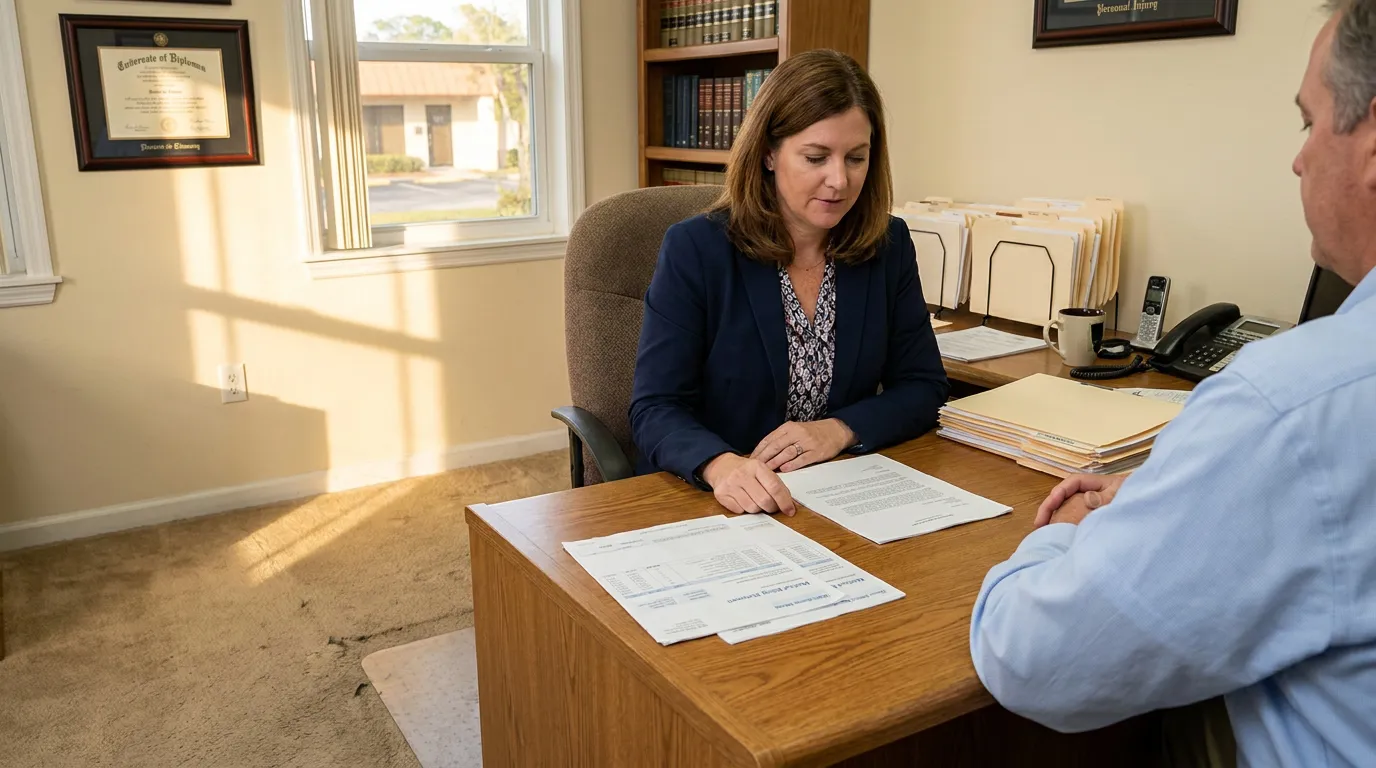
Why Villages Crash Victims End Up Treating on a Lien
Most people do not plan for a crash, and few carry coverage that absorbs a serious injury. Florida’s no-fault system provides fast, limited benefits regardless of fault, but with hard limits. When bills climb past the statutory cap, patients must choose between stopping treatment and finding a provider willing to defer payment.
Timing matters more than many realize. PIP benefits generally apply only if the injured person "receives initial services and care… within 14 days after the motor vehicle accident" under Fla. Stat. § 627.736(1)(a). Missing that window may eliminate no-fault medical coverage, pushing a patient toward a provider agreement earlier. If your treatment costs are exceeding your no-fault coverage, our discussion of auto accident bills beyond PIP limits walks through what typically comes next.
The contractual mechanism behind an LOP is not novel in Florida injury practice. The PIP statute itself recognizes assignments of benefits from patient to medical provider. A letter of protection operates on a similar principle: the provider looks to the claim rather than the patient’s wallet.
What the Florida 768.0427 Letter of Protection Statute Requires
Florida has a statute directly on point. Section 768.0427 is titled "Admissibility of evidence to prove medical expenses in personal injury or wrongful death actions; disclosure of letters of protection; recovery of past and future medical expenses damages."
The statute is organized into four operative subsections addressing key terms, evidentiary rules for proving medical expenses, disclosure obligations attached to letters of protection, and how amounts actually paid or payable may be presented. Readers can review the full text within the Florida Statutes chapter 768, keeping in mind that the statute generally applies to causes of action accruing on or after its March 24, 2023 effective date.
For a Villages auto accident victim, the practical takeaway is transparency. If your case proceeds into litigation, the LOP itself and the billing behind it may be subject to statutory disclosure and admissibility standards. That is not a reason to avoid treating on a lien; it is a reason to ensure the paperwork is accurate, complete, and handled by counsel from the outset.
Common Disclosure Issues to Anticipate
- The written LOP agreement itself, including any amendments
- The identity of who referred the patient to the treating provider
- Whether the provider’s charges are consistent with what it typically bills
- Whether any portion of the account has been sold or factored to a third party
💡 Pro Tip: Keep every document your provider gives you at intake. Under a florida 768.0427 letter of protection arrangement, disorganized records can complicate proving the reasonableness of your medical charges later.
How Comparative Fault Can Shrink the Fund That Repays Your Providers
The money that satisfies an LOP balance comes from the settlement or verdict, so anything that reduces recovery matters. Florida abandoned contributory negligence in Hoffman v. Jones, 280 So. 2d 431 (Fla. 1973). Florida has since moved from pure to modified comparative negligence: under Fla. Stat. § 768.81(6), for negligence causes of action accruing on or after March 24, 2023, a plaintiff found more than fifty percent at fault generally may not recover damages at all. A crash victim who is partially at fault but at or below that threshold may still recover, with damages reduced by his or her share of fault.
Apportionment cuts both ways. As discussed in the Florida Bar Journal’s analysis of comparative fault apportionment, a defendant generally pays damages "only in proportion to the percentage of fault by which that defendant contributed to the accident," quoting Fabre v. Marin, 623 So. 2d 1182, 1185 (Fla. 1993). If a jury assigns you a share of fault, your net recovery and the fund available to repay providers may shrink accordingly.
The Nonparty Problem and a Built-In Safeguard
Fault can also be assigned to people who were never sued. In Y.H. Invs. v. Godales, 690 So. 2d 1273, 1277 (Fla. 1997), the court confirmed that fault is compared among all entities who contributed to the accident "regardless of whether they have been or could have been joined as defendants." That may further reduce what is collected from the named defendant.
There is a meaningful procedural check. Under Fla. Stat. § 768.81(3)(a)1., a defendant who wants to allocate fault to a nonparty must affirmatively plead the nonparty’s fault and, absent a showing of good cause, identify the nonparty if known or describe the nonparty as specifically as practicable, either by motion or in the initial responsive pleading when defenses are first presented, subject to amendment any time before trial in accordance with the Florida Rules of Civil Procedure; and under Fla. Stat. § 768.81(3)(a)2., the defendant must also prove the nonparty’s fault by a preponderance of the evidence at trial in order to have the nonparty included on the verdict form. This burden can be difficult to carry, which may help protect accident victims counting on settlement proceeds to satisfy a medical provider lien.
Deadlines That Can Undo an LOP Arrangement
A Villages car accident claim is generally a negligence action, and Florida law now allows only two years from accrual to file suit. Under Fla. Stat. § 95.11(5)(a), "An action founded on negligence" falls under "WITHIN TWO YEARS." This two-year window replaced a four-year period through the 2023 tort reform amendment and generally applies to causes of action accruing on or after March 24, 2023.
Missing that deadline can have direct financial consequences for a patient treating on a lien. If there is no viable claim, there may be no settlement or verdict from which to pay, leaving the patient personally responsible for deferred bills.
| Type of Claim | Limitations Period | Statutory Source |
|---|---|---|
| Negligence (car crash) | Two years | Fla. Stat. § 95.11(5)(a) |
| Action on a written contract | Five years | Fla. Stat. § 95.11(2)(b) |
| Judgment of a Florida court of record | Twenty years | Fla. Stat. § 95.11(1) |
The contract side of an LOP generally follows a different clock. Because a letter of protection is a written agreement, a claim on that written instrument would generally fall under Florida’s limitations statute, which allows five years for "A legal or equitable action on a contract, obligation, or liability founded on a written instrument." If the balance is satisfied from a judgment rather than a settlement, Fla. Stat. § 95.11(1) provides twenty years for an action on a judgment of a court of record.
💡 Pro Tip: Verify which statutory year applies to your accident date. Annual statutory versions differ, and the version in effect when your claim accrued generally governs.
Practical Steps If You Are Considering Treatment on a Lien
Approach an LOP as a legal document, not a formality. Read what you sign, ask what happens if the case resolves for less than the billed amount, and confirm whether the provider will negotiate the balance at resolution. Providers are not required to reduce a lien, though many do.
Coordinate treatment with your claim. Gaps in care can complicate causation, and unexplained delays may give insurers an argument that the injury came from something else. Consistent, documented treatment supports both your health and your damages. If you want help evaluating whether an LOP fits your situation, a florida 768.0427 letter of protection lawyer can review the agreement before you sign.
Frequently Asked Questions
1. Do I need health insurance to use a letter of protection?
No, and that is often the point. LOP financing exists largely for people with no health insurance after a crash or with exhausted PIP benefits. Whether a provider will accept a lien depends on the provider and the claim strength.
2. What happens to my LOP if I lose the case?
The written agreement controls. Many LOPs make the patient ultimately responsible for the balance if no recovery occurs, though terms vary. Read the agreement carefully with counsel before treatment begins.
3. Does a letter of protection affect my case in court?
It can. Fla. Stat. § 768.0427 addresses disclosure of letters of protection and the admissibility of medical expense evidence, so the arrangement may become part of the record.
4. Can I still recover if I was partly at fault?
Often yes, but not always. For negligence claims accruing on or after March 24, 2023, a plaintiff more than fifty percent at fault is generally barred from recovering, and otherwise damages are reduced by the plaintiff’s percentage of fault. Fault may also be apportioned to nonparties, which may affect the fund available for repaying providers.
5. How long do I have to file my Villages crash lawsuit?
Generally two years for negligence claims accruing on or after March 24, 2023. Confirm the deadline early with an attorney.
Protecting Both Your Health and Your Claim
Letters of protection may fill a real gap for Villages residents whose Florida car accident care outlasts their no-fault benefits. They allow treatment to continue while a claim develops, but they also carry statutory disclosure obligations, contractual risk, and direct dependence on the eventual recovery. Comparative fault principles, including the greater-than-fifty-percent bar, apportionment to nonparties, and the two-year negligence deadline can all influence whether the arrangement works as intended.
If you are weighing treatment on a lien after a crash in The Villages, the attorneys at Glover Law Firm are available to review your agreement and your claim. Call 352-205-4495 or schedule a consultation to get started.
Disclaimer: This content is for informational purposes only and is not legal advice. Every case is unique, and results may vary. Consult an attorney about your specific circumstances.