
Filing a Golf Cart Accident Insurance Claim in The Villages, Florida After a Workplace Crash
Key Takeaways: A golf course maintenance worker suffered traumatic injuries in a May 2026 collision near the Village of Pennecamp, highlighting dangers on shared cart paths. Florida law provides multiple recovery avenues, including personal injury claims and workers’ compensation, but strict deadlines and government liability caps can limit compensation if victims delay. Understanding comparative fault, insurance exposure, and the two-year statute of limitations is essential for anyone injured in a golf cart crash in The Villages.
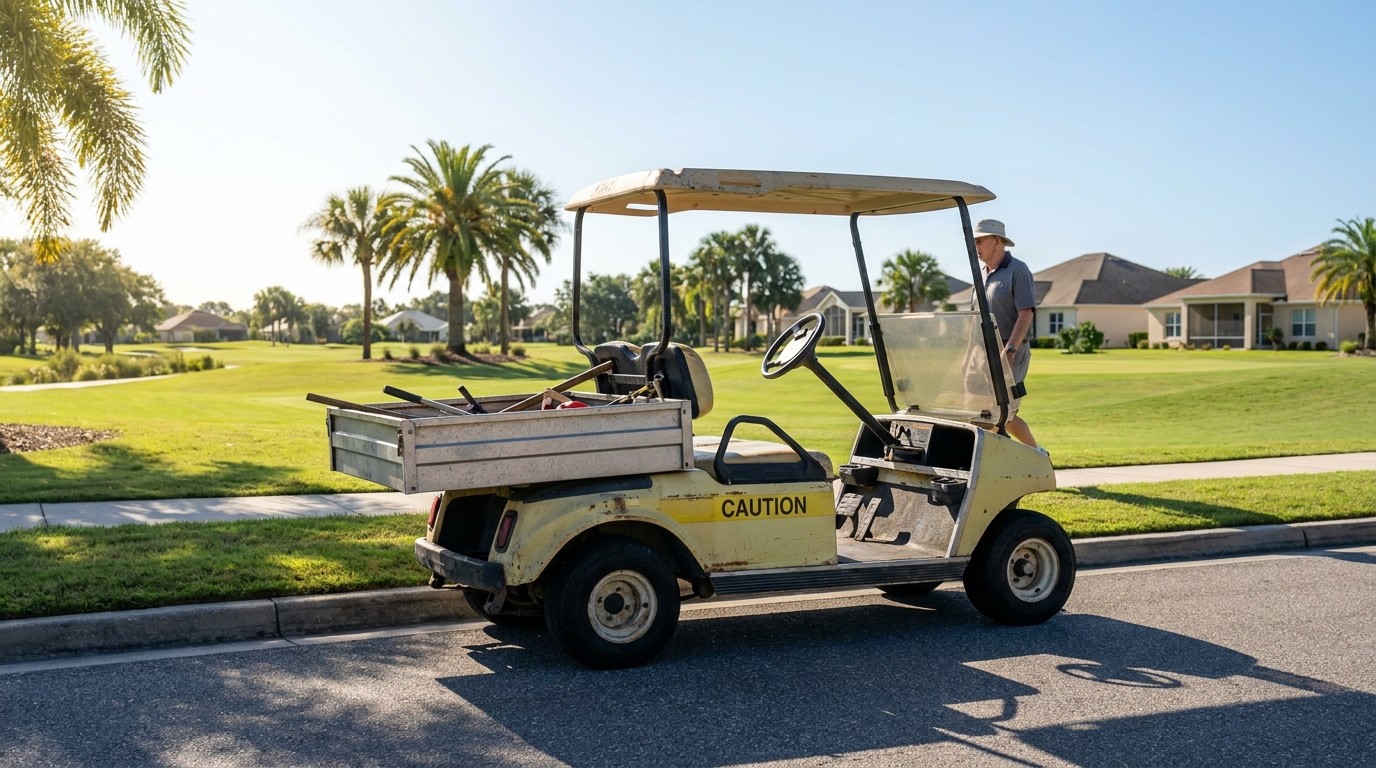
A 58-year-old golf course maintenance worker was rushed to Ocala Regional Medical Center in late May 2026 after his utility-style Club Car collided with an SUV near the Village of Pennecamp.
The worker, employed by ASG Solutions, was traveling from the Jacaranda Golf Course onto St. Charles Place when he failed to stop at a stop sign and drove into the path of a 2026 Hyundai Tucson.
The 81-year-old Pine Ridge resident driving the SUV also required emergency medical attention, while the maintenance worker was knocked from the cart and suffered traumatic, non-life-threatening injuries.
This incident raises critical questions about insurance coverage, liability, and legal options available to injured workers and bystanders.
A Dangerous Year for Golf Cart Travel in The Villages
The May crash was far from isolated.
Earlier in 2026, a Villager and her companion were killed after their golf cart overturned on U.S. Hwy. 27; a man was ejected and transported to a trauma center in Ocala; and another Villager was airlifted after a cart-vehicle collision.
An estimated 70,000 to 85,000 or more golf carts operate in The Villages, providing roughly 80 percent of resident trips, with nearly every household owning at least one and many households owning two.
That traffic volume, combined with golf cart vulnerability, creates an environment where serious injuries are increasingly common.
Golf carts lack structural protections that automobiles provide. According to a U.S. Department of Transportation technical report, golf carts offer limited crash protection because they are not engineered to meet passenger-vehicle crash-test standards. When a cart collides with a 4,000-pound SUV, the occupant absorbs nearly all impact force.
How Florida Law Governs Golf Cart Operations
Florida strictly regulates where golf carts may travel on public roads. Under F.S. § 316.212, a golf cart may only operate on roads officially designated for golf cart use by the responsible local governmental entity. Before designation, the authority must evaluate whether carts can safely travel on or cross the roadway based on traffic speed, volume, and character. If a crash occurs on an improperly designated road, both the operator and governing entity may face liability.
In The Villages, Community Development Districts (CDDs) function as government entities managing roads and cart paths. This matters because Florida’s sovereign immunity waiver under F.S. § 768.28 caps government liability at $200,000 per claim and $300,000 per incident, which may fall short of actual damages in catastrophic cases. A claimant may seek a legislative claim bill for amounts above the caps, but approval requires a separate act of the Legislature and is not guaranteed.
What a Victim Like the Injured Maintenance Worker Faces
Imagine you are employed by a contractor in The Villages, and your workday golf cart ride ends in a collision. You wake up in Ocala Regional Medical Center with broken ribs, a concussion, and no clear understanding of who is responsible for your medical bills. Your employer’s workers’ compensation may cover initial medical costs, but it will not compensate you for pain and suffering. Meanwhile, the other driver’s auto insurer has begun building a narrative to minimize their payout.
This is the reality for those navigating a golf cart accident insurance claim in The Villages, Florida. The legal landscape involves overlapping insurance policies, multiple potentially liable parties, and deadlines that begin running immediately. For someone focused on recovery, the complexity can feel overwhelming, which is why insurers count on delay and confusion to reduce payouts.
Liability, Fault, and Insurance: Who Pays After a Golf Cart Crash?
Florida uses a modified comparative fault system that directly affects recovery. Under F.S. § 768.81, a claimant found greater than 50 percent at fault for their injuries is barred from recovering damages. If the claimant’s fault is 50 percent or less, their award is reduced proportionately. Florida courts enter judgment against each liable party based on that party’s percentage of fault under several liability, meaning each defendant pays only their share.
Damages recoverable in a negligence action include:
- Past and future lost income (reduced to present value)
- Medical and funeral expenses
- Lost support and services
- Pain and suffering
- Punitive damages, where applicable
Understanding who may be liable for a golf cart accident in The Villages requires examining every party in the chain, from the cart operator and owner to the employer, the other driver, and potentially the government entity responsible for road design.
Workers’ Compensation vs. Third-Party Claims
For employees like the injured ASG Solutions worker, the legal picture splits into two tracks. Under Florida’s Workers’ Compensation Law (Chapter 440), an employer must pay compensation for disability resulting from an accident arising out of work performed in the course and scope of employment. However, workers’ compensation is typically the exclusive remedy against the employer, meaning the worker cannot sue the employer for additional negligence damages.
The critical exception involves third-party claims. If someone other than the employer caused or contributed to the crash, such as the Hyundai Tucson driver, the injured worker may pursue a separate personal injury lawsuit. This third-party claim is where compensation for pain and suffering, full lost wages, and other non-economic damages becomes available.
Important limitations apply. Workers’ compensation benefits may be denied or reduced if injury was caused primarily by the employee’s intoxication or drug influence under F.S. § 440.09. Additionally, if the worker pursues a third-party claim and recovers damages, the employer or its workers’ compensation carrier may assert a statutory lien against the recovery to recoup benefits already paid under F.S. § 440.39.
Filing Deadlines That Cannot Be Missed
Florida’s statute of limitations for negligence-based personal injury actions is two years from the date the cause of action accrues. Under F.S. § 95.11(4)(a), as amended by HB 837 in 2023, negligence claims are governed by a two-year deadline. However, strict liability and products liability claims are governed by a separate four-year statute under F.S. § 95.11(3)(d), and breach of warranty claims involving the sale of goods are governed by the Uniform Commercial Code (F.S. § 672.725) and carry a four-year limitations period; the four-year (oral) and five-year (written) limitations periods under F.S. § 95.11 apply to general breach of contract claims, not warranty claims. Missing the applicable window generally means losing the right to file suit entirely.
When a government entity like a CDD is involved, the timeline involves additional procedural steps. F.S. § 768.28(6) requires injured parties to present the claim in writing to the government agency and, except for claims against a municipality, county, or the Florida Space Authority, to the Department of Financial Services, within three years after the claim accrues. A claimant may not file suit until the agency denies the claim in writing or until six months have passed after the claim was filed without a final disposition, which is deemed a final denial by operation of law (90 days for medical malpractice or wrongful death claims). Courts interpret these requirements narrowly, and failure to comply can be fatal to a claim. Anyone pursuing a golf cart accident insurance claim in The Villages, Florida involving a government defendant should treat the notice requirement as an urgent first step.
How Does This Impact Me?
If I was injured in a golf cart crash, can I file both a workers’ comp claim and a personal injury lawsuit?
It depends on the circumstances. If you were working at the time, workers’ compensation may cover medical bills and a portion of lost wages. However, if a third party caused the collision, you may also have a separate negligence claim. The two tracks are not mutually exclusive, but coordinating them requires careful legal strategy because your employer’s workers’ compensation carrier may have a lien on any third-party recovery.
Does Florida’s comparative fault law mean I lose my case if I was partly at fault?
Not necessarily, but a critical threshold applies. Under Florida’s modified comparative fault system, your recovery is reduced by your percentage of responsibility. However, if you are found greater than 50 percent at fault (51 percent or more), you are barred from recovering any damages. For example, if you are 20 percent at fault and your damages total $100,000, you may recover $80,000. But if a jury finds you 51 percent at fault, you recover nothing.
What types of damages can I recover after a golf cart accident in The Villages?
Recoverable damages in a Florida negligence action may include past and future medical expenses, lost income, loss of earning capacity, pain and suffering, and in egregious cases, punitive damages. If a loved one was killed, surviving family members may pursue wrongful death claims. Available damages depend on injury severity and the conduct of at-fault parties.
How long do I have to file a golf cart accident insurance claim in The Villages, Florida?
The general statute of limitations for negligence-based personal injury claims in Florida is two years. However, if a government entity is potentially liable, you must present a formal written claim to the agency, and in most cases to the Department of Financial Services, before filing suit; you may not file suit until the agency denies the claim in writing or until six months have passed without a final disposition (90 days for medical malpractice or wrongful death), which is deemed a final denial. Courts interpret deadline exceptions narrowly, so do not assume any extension applies without consulting an attorney.
Should I talk to the other driver’s insurance company before hiring a lawyer?
Exercise caution. Insurance adjusters are trained to obtain statements and settlement agreements that protect their company’s financial interests, not yours. Anything you say may be used to reduce or deny your claim. Before providing a recorded statement or accepting any offer, consider speaking with a Villages golf cart accident attorney who can evaluate the full scope of your injuries and losses.
What Injured Residents and Workers Should Do Next
The May 2026 Pennecamp crash is a stark reminder that golf cart accidents in The Villages can produce life-altering injuries, and that the legal path to fair compensation is rarely simple. Between overlapping insurance policies, comparative fault calculations, workers’ compensation exclusivity rules, and government liability caps, injured victims face a system designed to limit payouts. Acting quickly to preserve evidence, document injuries, and understand filing deadlines is the single most important step any injured person can take.
This article provides general legal information and does not constitute individualized legal advice. Outcomes depend on the specific facts and circumstances of each case.
If you or someone you care about was hurt in a golf cart accident in The Villages, Glover Law Firm can help you understand your legal options and navigate the claims process. Call 352-205-4495 to speak with an attorney, or contact us today to schedule a consultation.